
The Poll Is Dead. Long Live the Simulation.
SimulationAgent.ai | May 2026
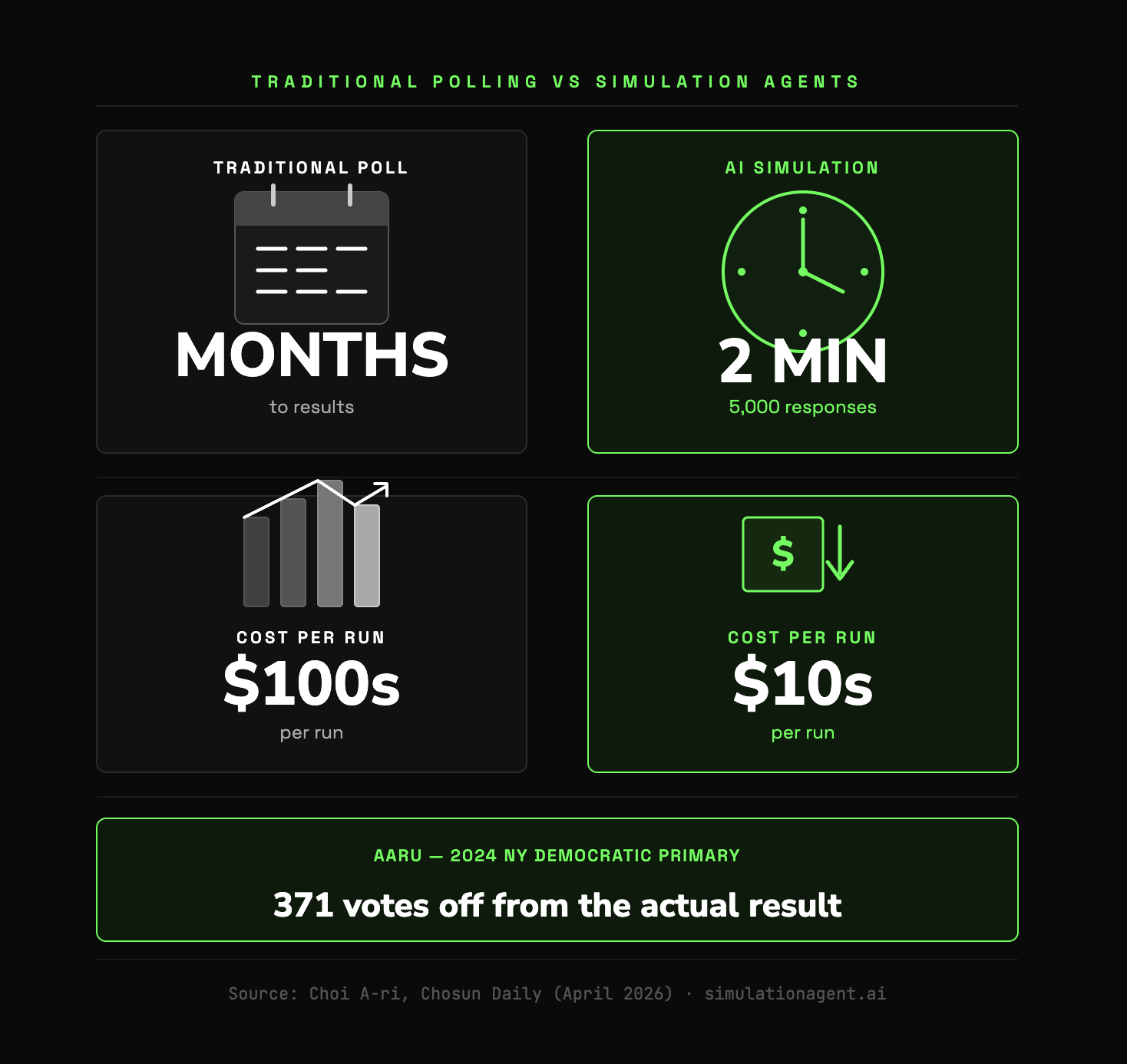
Something significant happened in early 2025 that most people missed: the cost of running thousands of AI agents simultaneously dropped from hundreds of dollars to tens of dollars. That single economic shift — quiet, unglamorous, buried in infrastructure pricing — is what's turning multi-agent simulation from a research curiosity into a market.
The evidence is now hard to ignore.
MiroFish, built in 10 days by a 20-year-old college student, topped GitHub's trending list by doing something conceptually simple: drop a news article, policy draft, or financial report into a virtual social space populated by thousands of AI personas with distinct personalities and biases, then watch how opinion spreads. Users can inject unexpected variables mid-simulation and interview individual agents afterward — "What made you change your position?" — and get coherent answers.
Aaru, founded in 2024 by three teenagers, is now valued at $1 billion. When a client specifies a target demographic — "50-year-old male, Seoul resident, two children, conservative tendencies" — Aaru generates virtual consumers and extracts 5,000 responses in two minutes. Traditional market research doing the same job takes months and costs tens of millions of won. In the 2024 New York Democratic primary, Aaru's simulation differed from the actual result by 371 votes.
Intellicia, a South Korean startup, has cut consumer surveys from 4-6 weeks to under 30 minutes. Nielsen launched an AI screener combining real purchase data with generative AI. Ipsos commercialized Personabot for real-time conversations with virtual consumers. Stanford's Dr. Park Junseong — whose Smallville research placed 25 AI agents in a virtual town where they autonomously formed relationships — launched Simile, a platform for simulating human decision-making in consumer purchases and policy responses, backed by OpenAI co-founder Andrej Karpathy.
This is no longer fringe research. It's a market with real clients, real revenue, and real predictions being acted upon.
The Cost Collapse Is the Real Story
The accuracy numbers get the headlines. The cost collapse is what changes everything.
When running a multi-agent simulation costs tens of dollars instead of hundreds, the barrier to entry drops to nearly zero. A startup founder can run 50 scenario simulations before a board meeting. A campaign can test policy messaging against a virtual electorate overnight. A product team can pressure-test a launch against 10,000 synthetic consumers before spending a dollar on manufacturing.
This is the same dynamic that made cloud computing transformative — not that it was technically possible, but that it became cheap enough to use recklessly. The implications for how organizations make decisions are significant and largely unexamined.
The Responsibility Side
The researchers and practitioners in this space are being appropriately cautious, and their cautions are worth taking seriously.
Multi-agent simulations are tools for exploring possibilities, not absolute predictors. AI cannot replicate physical experience — a simulation cannot tell you how a car feels to drive, how a perfume smells, or how a meal lands. And it struggles with genuinely unpredictable human behavior: erratic political decisions, black swan events, cascading social dynamics that emerge from real friction rather than modeled friction.
There's also a subtler risk: simulations trained on existing data will reflect existing patterns. If historical polling data carries demographic blind spots — and it does — then a simulation trained on that data inherits those blind spots, potentially with more confidence and less visibility than the original polls.
The most dangerous version of this technology isn't one that's obviously wrong. It's one that's right often enough to be trusted without sufficient scrutiny, then catastrophically wrong at a moment that matters.
What This Means for Simulation Agents
The polling and market research application is one vertical. But the underlying capability — generating synthetic populations of agents with distinct personalities, injecting variables, observing emergent behavior — is the foundation of simulation agents broadly.
What's being built for election forecasting today is the same infrastructure that will be used for organizational decision modeling, strategic planning, crisis simulation, and — as we covered in a previous post — forensic risk assessment. The applications will multiply faster than the governance frameworks designed to constrain them.
That's not an argument against the technology. It's an argument for building it carefully, with human oversight mechanisms baked in from the start rather than retrofitted after the first high-profile failure.
The organizations that get this right will have a genuine strategic advantage. The ones that don't will generate the next wave of documented AI incidents.
The Signal
A 20-year-old builds a multi-agent simulation platform in 10 days. Three teenagers found a company now worth $1 billion. A Stanford researcher spins up a commercial platform backed by one of the most prominent names in AI.
The signal is clear: multi-agent simulation has crossed from research into product. The question now isn't whether simulation agents will reshape how organizations understand human behavior. It's whether the people building them understand what they're actually building.
Sources: Choi A-ri, Chosun Daily, April 2026 | Aaru | MiroFish | Intellicia | Stanford Simile
Feature Image: Mario Verduzco on Unsplash
SimulationAgent.ai tracks developments in simulation agents, digital twins, and autonomous AI ecosystems. The opportunity is real. So is the responsibility.