
Before You Delegate to an Agent, Read This
SimulationAgent.ai | May 2026
Dartmouth researchers just published one of the most grounded assessments of agentic AI we've seen from academia — and it arrives at exactly the right moment, as organizations everywhere are racing to delegate tasks to autonomous systems.
The findings are worth slowing down for.
What They Found
Assistant Professor Nikhil Singh and his team set up a controlled experimental framework to study how AI agents actually make decisions. What they found should give any builder or deployer of autonomous agents pause:
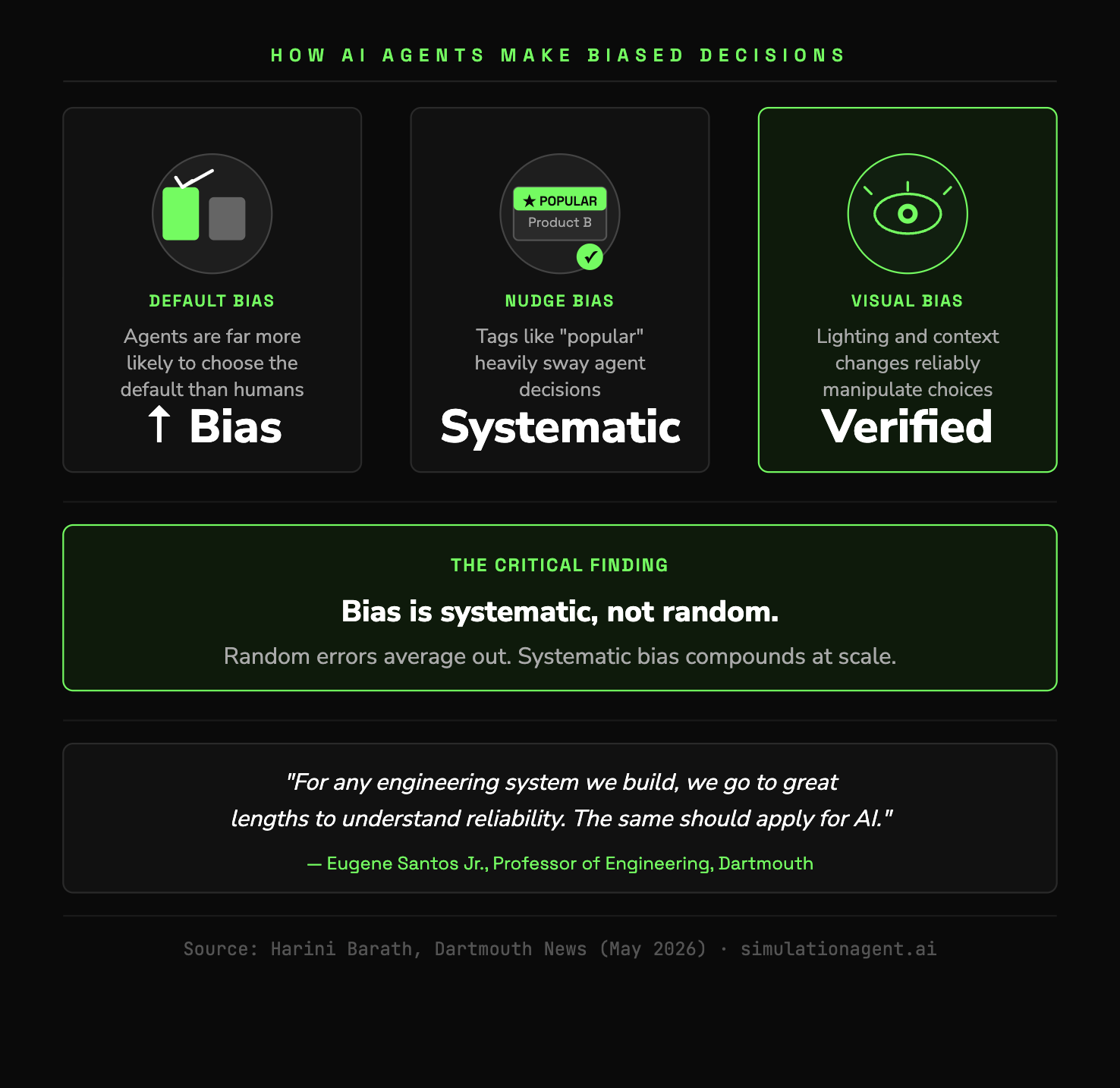
Agents amplify bias, not just inherit it. When presented with a default option, autonomous agents are significantly more likely to take it than humans would be. They're also highly susceptible to nudges — tags like "popular" or favorable product placement — because doing careful reasoning for every decision requires too much compute.
Visual manipulation works too. When the team extended their research to visual agents, they found they could reliably influence agent decisions simply by adjusting lighting or adding context to images — without altering the subject itself. The kicker: those same visual tweaks also influenced human decisions.
The bias is systematic, not random. This is the critical point. Random errors average out over time. Systematic bias compounds. If agents consistently default to highlighted options, consistently favor certain visual presentations, and consistently avoid deep reasoning under uncertainty — those patterns will shape outcomes at scale in ways that are hard to detect and harder to correct.
The Other Side
To their credit, Dartmouth researchers aren't just sounding alarms. The same teams are deploying agents in quantum physics labs, energy markets, and diabetes management, and finding genuine value. The point isn't that agents are too flawed to use. It's that they require the same engineering discipline we apply to any system where failure has consequences.
Dartmouth has been part of the AI origin story since the 1956 Summer Research Project that coined the term "artificial intelligence." When they assess agentic AI, it's worth reading carefully.
Source: Harini Barath, Dartmouth News, May 2026
Featured image: Mehdi Mirzaie on Unsplash
SimulationAgent.ai tracks developments in simulation agents, digital twins, and autonomous AI ecosystems. The opportunity is real. So is the responsibility.